What Distinguishes Public Transport from Car Rental in Aruba?
Public transport costs $2.60 per ride versus $35-75 daily for car rental, but limits you to paved routes serving 60% of tourist sites. The Arubus system connects Palm Beach, Eagle Beach, and Oranjestad on fixed schedules (every 15-20 minutes peak hours), while rental cars—especially 4x4s—access Arikok National Park’s 34 km² and the northern coast’s unpaved terrain where buses cannot reach.
How Does the Public Transport System in Aruba Operate?
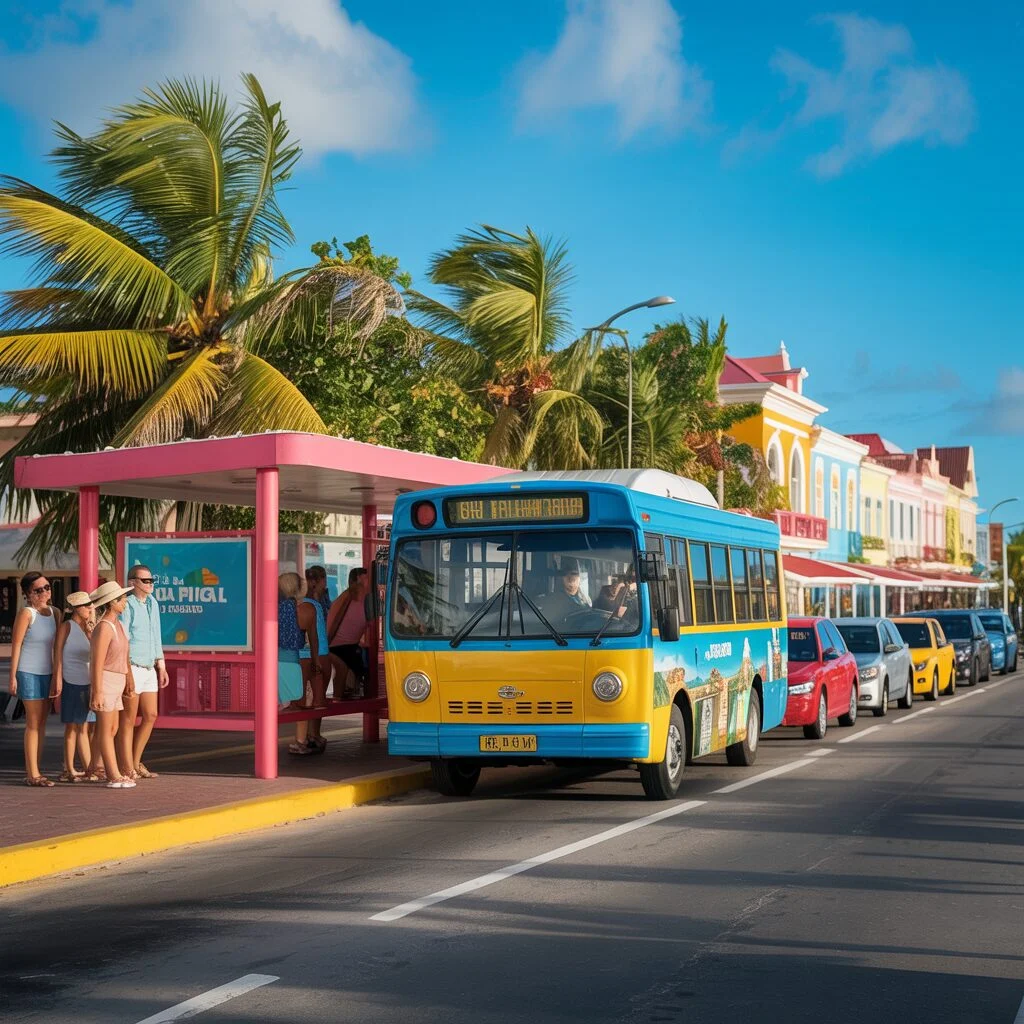
Aruba’s government-owned Arubus network runs 10+ routes connecting major zones with regulated taxis filling coverage gaps. Route 10 serves 80% of tourist accommodations along the 7 km hotel strip, operating 5:30 AM to midnight weekdays with reduced Sunday service.
What Is the Arubus Service and Where Does It Go?
Route 10 connects Palm Beach to Oranjestad every 15-20 minutes during peak hours, covering the 12 km distance in 35-40 minutes with 15+ stops. Route 1 serves Queen Beatrix International Airport (3 km from Oranjestad), while Route 2 reaches San Nicolas (18 km south) in 45 minutes.
- Route 1: Airport-Oranjestad corridor, 6 AM-11 PM service,
- Route 2: Oranjestad-San Nicolas, hourly departures,
- Hotel Strip Connections: 12 designated stops between high-rise (Palm Beach) and low-rise (Eagle Beach) zones.
How Do Taxi Services Supplement Public Transit?
Fixed-rate taxis charge $25-30 for airport transfers versus $2.60 bus fare, operating 24/7 where buses stop at midnight. Government-regulated rates eliminate meter uncertainty: Oranjestad to Palm Beach costs $22, to Baby Beach $45.
What Are the Schedules and Frequency of Public Buses?
Route 10 runs every 15 minutes weekdays 7 AM-7 PM, extending to 20-30 minute intervals evenings and Sundays. Last departures leave Oranjestad at 11:45 PM weekdays, 10:30 PM Sundays—missing these requires $20-25 taxi rides.
How to Handle Ticketing and Payment for Public Transport
Single rides cost $2.60 (AWG 4.60), day passes $10 (unlimited rides), weekly passes $25. Buses accept US dollars and Aruban florins; carry bills under $20 as drivers stock limited change for $50-100 notes.
What Should You Know Before Renting a Car in Aruba?
Rental cars cost $35-75 daily (compact to SUV) plus $15-25 mandatory insurance, requiring drivers 23+ years old with valid licenses and credit cards for $300-500 deposits. 4×4 vehicles are essential for 40% of island attractions on unpaved roads.
What Are the Requirements for Booking a Rental Car?
Drivers need valid licenses (no international permit for US/EU visitors), minimum age 23-25 depending on agency, and credit cards for deposits. Under-25 drivers pay $10-15 daily surcharges at most agencies.
How Do Road Conditions Affect Driving in Aruba?
Paved roads cover 60% of tourist routes (hotel zones, Oranjestad, airport), while Natural Pool access requires 8 km of rocky terrain navigable only by 4x4s. Standard sedans risk tire damage and suspension failure on unpaved northern coast roads.
What Is the Availability of Parking for Rental Cars?
Free parking exists at 90% of beaches and hotels outside Oranjestad, where metered spots cost $1-2 hourly. Downtown parking fills 10 AM-4 PM weekdays; paid lots charge $5-8 daily versus free street parking 500m from center.
What Safety Considerations Apply to Car Rentals?
Right-hand traffic matches US/Canada standards. Roundabouts require yielding to circulating traffic—80% of intersections use this system. Wildlife (goats, donkeys) causes 15% of rural accidents; drive under 40 km/h after sunset in non-urban areas.
Comparing Cost Efficiency Between Transport Modes
Solo travelers spend $20-30 weekly on buses versus $350-600 for car rentals (including insurance and fuel). Groups of 3+ split rental costs to $25-40 per person daily, matching or beating bus passes when visiting 5+ locations daily.
How Do Daily Bus Fares Compare to Rental Rates?
Bus day passes cost $10 versus $50-100 daily car rental base rates. Solo travelers save $280-630 weekly using buses for hotel-beach-Oranjestad routes, while families of 4 pay $40 daily for passes versus $60-75 split rental costs.
| Expense Category | Public Transport (Arubus) | Car Rental |
|---|---|---|
| Base Cost | $2.60 per ride, $10 day pass | $35-75 daily rate |
| Upfront Investment | $0 | $300-500 deposit |
| Ideal For | Solo/couples, beach-focused stays | Groups 3+, island-wide exploration |
What Hidden Costs Should You Expect with Car Rentals?
Mandatory insurance adds $15-25 daily (43-50% of base rate). Fuel costs $30-50 weekly for 200-300 km typical driving. Oranjestad parking fees total $10-15 weekly; off-road tire damage costs $100-200 if not covered by insurance.
Analyzing Travel Flexibility and User Convenience
Rental cars eliminate 30-45 minute bus waits and enable 24/7 access to 15+ beaches versus 8 bus-accessible locations. Buses require schedule alignment—last departures at 11:45 PM force early beach exits or $25 taxi rides.
How Does Car Rental Enhance Travel Freedom?
Cars provide 24/7 mobility versus bus service ending at midnight, allowing sunrise visits to California Lighthouse (6 AM) and sunset stays at Baby Beach without schedule constraints. Trunk space accommodates coolers, snorkel gear, and beach chairs impossible on buses with 2-bag limits.
What Are the Constraints of Relying on Public Transport?
Buses serve 8 of 20+ major beaches, missing Boca Prins, Dos Playa, and Natural Pool entirely. Route 10’s 15-20 minute frequency becomes 30-45 minutes evenings/Sundays, adding 1-2 hours daily to multi-stop itineraries versus direct car routes.
How Does Travel Duration Differ Between Bus and Car?
Palm Beach to Baby Beach takes 45 minutes by car versus 90-120 minutes by bus (including Oranjestad transfer and 12+ stops). Daily time savings of 2-3 hours enable visiting 5-6 locations versus 2-3 by bus.
Infrastructure and Accessibility Factors
Arubus serves 85% of hotel zones with air-conditioned buses and 40+ marked stops, but 300-500m walks to stops in 32°C heat challenge mobility-limited visitors. Taxis and rentals provide door-to-door service eliminating heat exposure.
How Accessible Is Public Transport for Tourists?
Modern air-conditioned buses serve Palm Beach, Eagle Beach, and Oranjestad with wheelchair-accessible vehicles on Route 10. However, 300-500m average walk distances to stops in 32°C temperatures and limited shade at 60% of stops reduce accessibility for elderly/disabled travelers.
What Infrastructure Supports Public Transport in Aruba?
Oranjestad’s central terminal connects all 10+ routes with covered waiting areas and real-time displays. 40+ marked stops along main boulevards include shelters at 40% of locations; remaining stops offer minimal shade in tropical sun.
Environmental Impact of Transport Options
Buses reduce per-passenger emissions by 75% versus rental cars—one bus replaces 30-40 vehicles. Aruba’s 40,000+ annual rental vehicles (mostly SUVs averaging 12 L/100km) contribute 15% of island traffic emissions versus 3% from public transit.
Which Transportation Method Fits Your Travel Style?
Choose buses for beach-resort stays within 2 km of stops, saving $280-630 weekly. Rent cars for itineraries visiting 5+ daily locations or accessing Arikok National Park’s 34 km² and northern coast sites unreachable by bus.
When Should You Choose Public Transport?
Select buses when staying in Palm/Eagle Beach zones and visiting 2-3 bus-accessible beaches daily. Budget travelers save $40-60 daily versus rentals; couples spending 80%+ time at resort beaches need only $20-30 weekly for occasional Oranjestad trips.
When Is Renting a Car the Superior Option?
Rent for Arikok National Park access (34 km² requiring 4×4), northern coast exploration (8+ beaches unreachable by bus), or families/groups of 3+ splitting $60-75 daily costs to $20-25 per person—matching bus pass rates while gaining flexibility.
What Alternative Transport Options Exist in Aruba?
Scooter rentals cost $25-40 daily for 50cc models accessing paved routes; ATV rentals run $75-120 daily for off-road capability. Bicycle rentals ($10-15 daily) suit flat 7 km hotel strip exploration; hotel shuttles provide free casino/shopping transport within 5 km radius.